
Table of Contents
Every Engineering Manager makes this call, even if nobody says it out loud. You either plan your air compressor maintenance, or you run the machine until it stops. Both choices cost money. Only one of them lets you decide when to spend it. This guide explains what run to failure really costs, what planned maintenance covers, and how to switch without drama.
What “run to failure” means
Run to failure is exactly what it sounds like. You skip routine servicing. The compressor runs until something breaks. Then you call for help and wait.
Plenty of sites work this way without ever choosing it. The compressor sits in a corner. It makes air every day. Nobody touches it until the day it does not.
It feels free. It is not.
The real cost of running to failure
Downtime picks its own moment
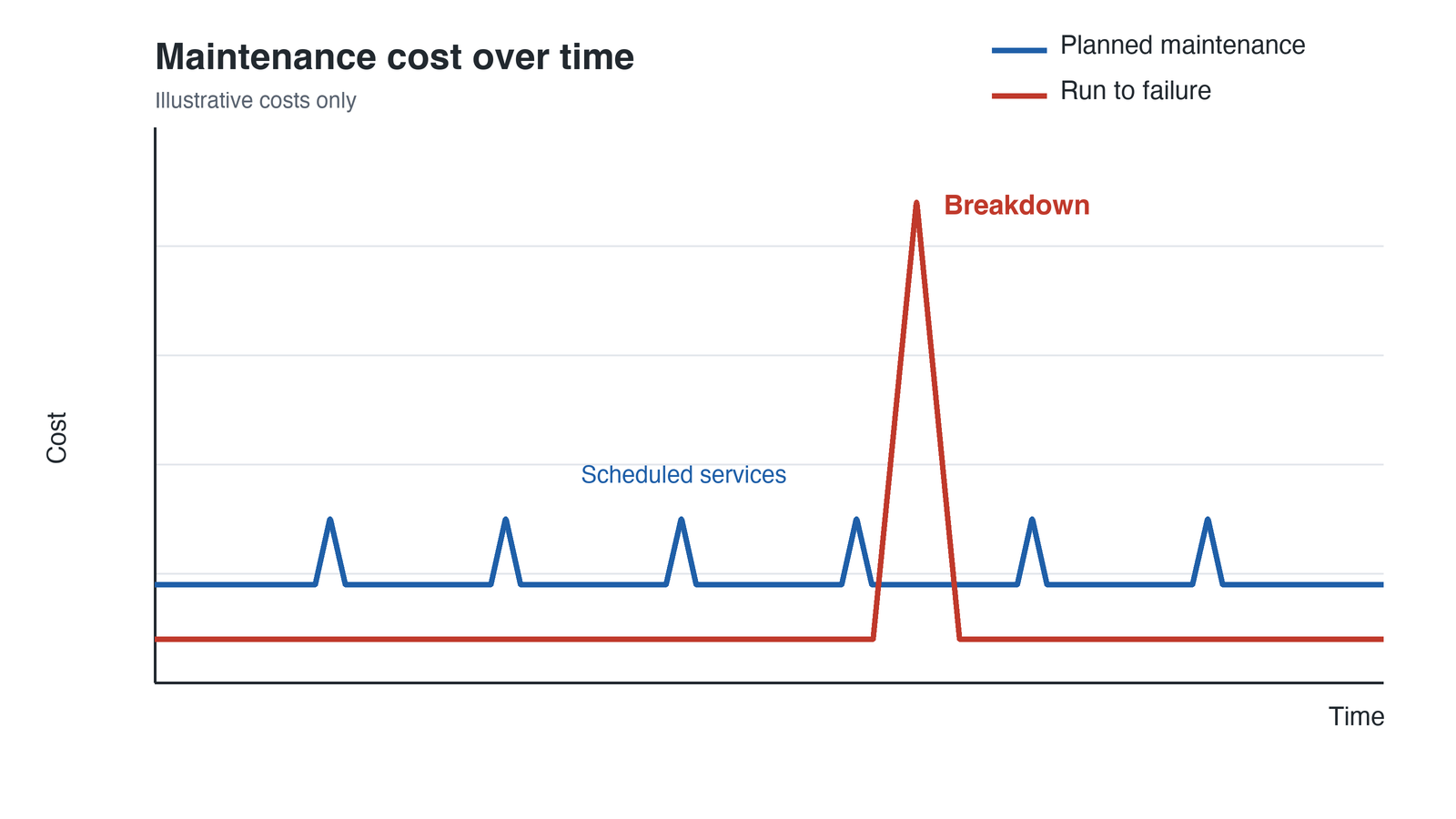
A compressor does not fail on a quiet Friday afternoon. It fails mid shift, mid order, mid peak season. If your production lines, tools, or packaging kit run on compressed air, the whole plant stops with it. Now you are paying idle staff and missing dispatch dates while you wait for an engineer and parts.
Your energy bill creeps up first
A neglected compressor does not just break. It gets expensive long before that. Clogged filters make the unit work harder to deliver the same air. Worn parts drag efficiency down. Unfixed leaks bleed air day and night. Air-Mech’s ultrasonic surveys typically find 20 to 30 percent of energy wasted through air leaks.
That matters because energy is the biggest cost of owning a compressor. The US Department of Energy’s compressed air sourcebook puts energy at around three quarters of a compressor’s lifetime cost (source: Improving Compressed Air System Performance, US DOE / Compressed Air Challenge). The purchase price is the small number. The running cost is the big one.
Small faults grow into big ones
A worn bearing is a cheap part. Ignore it and it can take out the airend, the heart of the machine. At that point you are not booking a service. You are pricing a rebuild or a new compressor. Run to failure turns small problems into expensive ones.
The legal bit: PSSR
Most industrial compressed air systems in the UK fall under the Pressure Systems Safety Regulations 2000. That usually means you need a written scheme of examination, and you must keep the system examined and maintained in line with it (source: HSE, Pressure Systems Safety Regulations). Run to failure makes that duty hard to evidence. Planned maintenance gives you the paper trail.
What planned air compressor maintenance covers
Planned maintenance is not complicated. An engineer visits on a schedule and works through the machine before anything fails. A proper visit covers:
- Air and oil filters changed, not just checked.
- Oil and separators replaced at the right hours.
- Belts, hoses, and couplings inspected for wear.
- Condensate drains and dryers checked, so moisture does not reach your tools or product.
- Operating temperatures and pressures logged against the manual.
- A leak check, because leaks come back.
- Service records kept, which supports your PSSR written scheme.
The goal is simple. Find the small problem while it is still small.
Planned vs run to failure, side by side
| Planned maintenance | Run to failure | |
|---|---|---|
| When you pay | On a date you choose | Whenever it breaks |
| Downtime | Short, scheduled | Long, unplanned |
| Energy use | Kept in check | Creeps up unnoticed |
| Repair size | Small parts, on time | Big failures, under pressure |
| PSSR evidence | Records build up | Gaps build up |
| Budgeting | Predictable | Spiky and painful |
How often should you service an air compressor?
Check your manual first. Most manufacturers set service points by running hours. As a rule, do not let a working industrial compressor go more than a year without a service, even at low hours.
Two things move the schedule:
- Running hours. A compressor on double shifts needs attention far sooner than one that runs a few hours a day.
- Environment. Dusty, hot, or damp plant rooms clog filters and stress coolers faster.
If you do not know your unit’s running hours, fix that first. The hours counter is the honest record of how hard the machine works.
How to switch from run to failure to planned maintenance
You do not need a big project. You need five steps.
- List your kit. Every compressor, dryer, and receiver, with model, age, and running hours.
- Dig out the manuals. Note the service intervals for each unit.
- Get a baseline. Have an engineer survey the system once, so you know what state it is really in.
- Fix the leaks. It is usually the fastest payback in the whole plant. Our guide on what air leaks cost shows why.
- Book the schedule. Put the service dates in the calendar and keep the records with your written scheme.
From there it runs itself. A planned compressor servicing programme does the remembering for you.
Does planned maintenance actually work?
Yes, and not just in theory. When Costco moved to planned maintenance with Air-Mech, repeat compressor faults fell by 43 percent across its UK sites (read the case study). Fewer faults means fewer stoppages, fewer emergency call outs, and a compressor room nobody has to think about.
That is the whole case for planned air compressor maintenance. Not perfection. Just fewer bad surprises, at a price you agreed in advance.
If you want a straight answer on what your own system needs, talk to our engineers. No hard sell. Just a look at your kit and an honest recommendation.